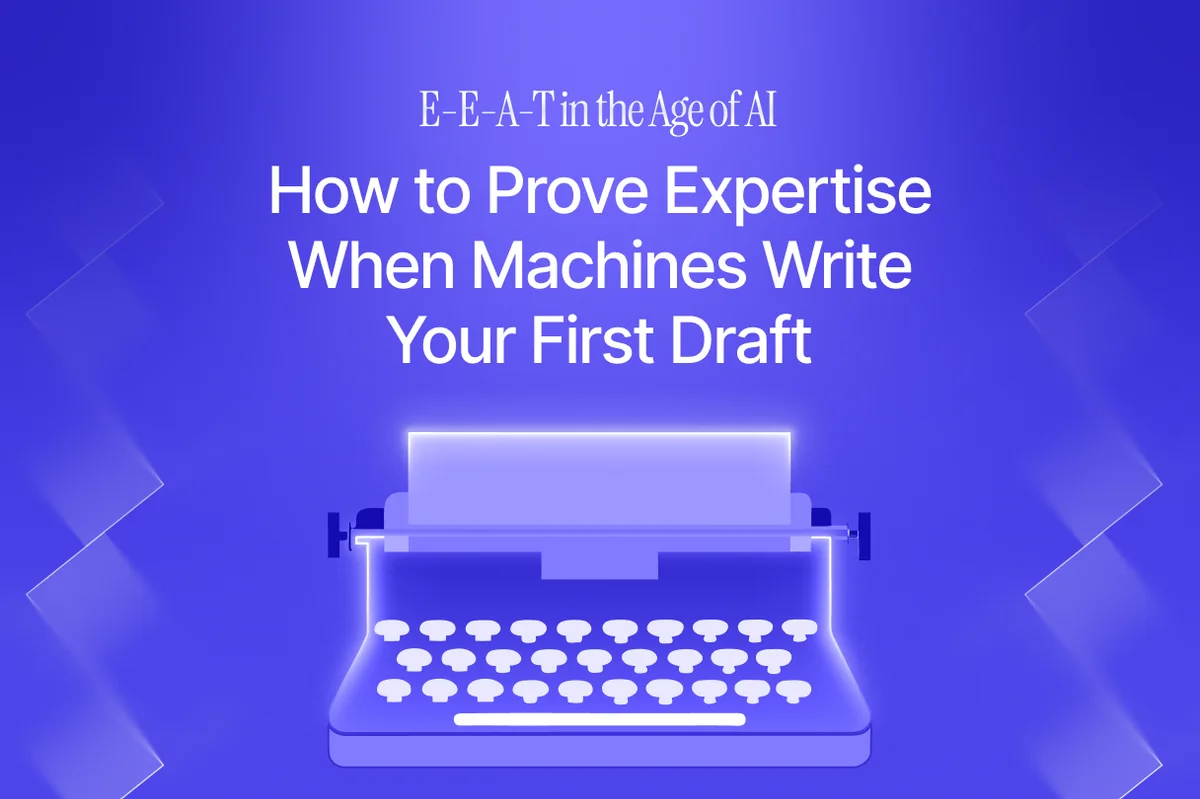
E-E-A-T (Experience, Expertise, Authoritativeness, Trustworthiness) is more important in 2026 than it was when Google introduced the framework, not less. The reason: AI engines extracting citations need trust signals to decide which sources to cite, and Google's algorithm uses E-E-A-T as one of those signals. The tension is real: marketing teams are using AI to draft content faster than ever, which dilutes the very expertise markers E-E-A-T depends on. Brands that win in 2026 use…
TL;DR: E-E-A-T (Experience, Expertise, Authoritativeness, Trustworthiness) is more important in 2026 than it was when Google introduced the framework, not less. The reason: AI engines extracting citations need trust signals to decide which sources to cite, and Google's algorithm uses E-E-A-T as one of those signals. The tension is real: marketing teams are using AI to draft content faster than ever, which dilutes the very expertise markers E-E-A-T depends on. Brands that win in 2026 use AI as a drafting tool but preserve the human expertise layer (named bylines from genuine practitioners, first-party data from real engagements, opinions that contradict consensus, specific client examples). Brands that ship AI-generated content unedited dilute E-E-A-T and lose both Google rankings and AI citations.
I've reviewed AEO-focused B2B SaaS client content where the brand insists on shipping AI-generated drafts unedited. Every single time, two things happen: organic rankings stall, and AI engines cite competitors instead. The root cause is the same. The content has no expertise markers. The author byline is generic. The opinions are consensus. The examples are invented. Both Google's algorithm and AI engines downrank content like this for the same reason: it lacks demonstrable Experience, Expertise, Authoritativeness, and Trustworthiness.
This piece walks through what E-E-A-T means in 2026, why AI changed the stakes, and how brands actually preserve expertise markers while still using AI in production.
For broader AEO context, see Answer Engine Optimization Guide for 2026. For Share of Answer measurement, see Share of Answer: The New Ranking Metric.
What is E-E-A-T in the age of AI search?
E-E-A-T is Google's quality framework: Experience, Expertise, Authoritativeness, Trustworthiness. In the AI search era, it functions as a dual signal. Google's algorithm still uses E-E-A-T to rank pages. ChatGPT, Claude, Perplexity, Gemini, and Google AI Overviews use the same kinds of expertise markers to decide which sources to cite inside generated answers. A page that lacks expertise signals loses on both surfaces at once.
The 2026 version of the framework is harsher than the 2022 version. Marketing teams are now using AI to draft content at a velocity that dilutes the very expertise markers the framework rewards. Generic AI-drafted content with no named author, no first-party data, no specific client examples, and no opinions that contradict consensus gets downranked by Google and ignored by AI engines for the same reason: there is nothing in the content that proves a human practitioner wrote it from real experience.
Three signals carry most of the weight in 2026:
- Named practitioner bylines from people with verifiable industry experience. Generic editorial bylines or anonymous "team" attributions fail. The byline has to be a real person with a LinkedIn profile, public talks, or named client work behind them.
- First-party data from real engagements. Specific client outcomes, citation rate numbers, prompt-level results. Invented stats fail because they cannot be cross-referenced.
- Opinions that contradict consensus. Consensus content is interchangeable, and engines treat it as such. A piece that takes a defensible contrarian position becomes a distinctive source that gets picked over interchangeable competitors.
What E-E-A-T actually means in 2026
Google's framework, in plain terms:
- Experience. The author has personally done the thing they're writing about. They've shipped the product, run the agency, served the clients. Not just researched the topic from secondary sources.
- Expertise. The author has demonstrable depth in the domain. Credentials matter for medical or financial topics; lived practice matters for most others.
- Authoritativeness. The author and brand are recognized as legitimate voices in the category. Cited by peers. Linked from authoritative sources.
- Trustworthiness. The content makes accurate claims, cites real data, transparent about who wrote it, sources verifiable.
Google updated the framework from E-A-T to E-E-A-T in late 2022 specifically because AI-generated content lacking lived Experience was flooding the web. The "first E" was Google's attempt to push back against undifferentiated AI slop.
Why E-E-A-T matters more for AI citations than for SEO
Three structural reasons:
- AI engines need trust signals to pick citations. When ChatGPT decides which 3-5 brands to cite in response to "what's the best Webflow agency for B2B SaaS?", it weights extractable content quality and source authority. Sources without E-E-A-T signals (named authors with real expertise, first-party data, recognized brands) get filtered out.
- Google's algorithm increasingly factors E-E-A-T into ranking. Google's Helpful Content Update and subsequent core algorithm updates have penalized content lacking expertise markers. SEO programs that produced AI-generated content unedited saw 20-50% traffic drops during 2024-2025.
- Buyer skepticism of AI content is high. Even when AI-generated content ranks, buyers increasingly read past it. The conversion impact of expertise-signaling content (founder byline, real client names, specific results) is measurable.
The AI drafting tension
Marketing teams have a real productivity benefit from using AI in content production. The drafting time reduction is 30-60% on structured content. The temptation: ship AI drafts unedited because the throughput is so much higher.
The trap: AI drafts have predictable failure modes that destroy E-E-A-T:
- Generic author bylines. AI-drafted pieces under bylines like "The Marketing Team" or "John Smith, Content Marketing Manager" lack Experience signals. Strong E-E-A-T requires the actual practitioner who did the work to be the byline.
- Consensus opinions. AI models trained on the open web produce consensus framing. "Many experts believe..." "It's widely accepted that..." Consensus is the opposite of expertise.
- Invented examples. AI hallucinates client names, statistics, and case studies. When fact-checked, these collapse and destroy Trustworthiness.
- Surface-level reasoning. AI drafts identify the obvious 2-3 reasons something is true. Real expertise sees the 7th, 8th, and 9th reasons that aren't obvious. The depth differential is the expertise differential.
How brands actually preserve E-E-A-T while using AI
Five operating principles:
1. Use AI for structure, not for thinking
AI drafts the outline and the structural scaffolding. The actual thinking (the opinions, the contrarian takes, the specific client examples, the lessons learned) comes from the practitioner. The AI assists; the practitioner directs.
2. Named bylines from genuine practitioners
The byline on every cornerstone piece is a real person who has done the work being written about. The founder of the agency. The senior engineer who led the migration. The marketing lead who ran the campaign. Generic bylines ("Editorial Team") destroy Experience signals.
3. First-party data over secondary research
Every cornerstone piece cites first-party data from real engagements rather than secondary research from competitor blogs. "We helped CodeOp grow organic clicks +49% YoY" beats "industry benchmarks suggest content marketing can deliver 50% organic growth." Specific beats general.
4. Real client names where consent permits
Named clients (Toku, CodeOp, Zeiierman, TradeMomentum) with consented case studies are E-E-A-T gold. Anonymous "a B2B SaaS client" beats no example but doesn't compete with named, named clients. Where clients can't be named, use specific industry + situation context.
5. Opinions that contradict consensus
The clearest expertise signal: stating an opinion that contradicts what an AI model would generate by default. Consensus opinions are easy to produce; contrarian opinions require actual depth. The 40-60 word direct-answer block is a place to put the contrarian take.
What E-E-A-T destruction looks like in production
Six patterns I see repeatedly in audits:
- Bylines under "Marketing Team" or "Content Editor." No real person attached.
- Repeated phrases like "industry experts," "leading practitioners," "studies show." AI consensus-framing tells without specific attribution.
- Statistics without source links. "73% of B2B SaaS marketers report...", from where? Real data is linkable; invented data isn't.
- Generic case studies. "Company X grew Y% by doing Z." Anonymous, unverifiable. AI engines downrank.
- No first-party photos, screenshots, or videos. Stock imagery only. Real practitioners have real artifacts.
- About pages that don't name the actual people running the company. Team pages with stock photos of generic professionals. Trust destruction at the foundation.
How to audit your site for E-E-A-T
Five checks:
- Every cornerstone piece has a named byline of a real practitioner. If not, fix.
- Every cornerstone piece cites first-party data or specific client outcomes. If not, fix.
- The About page lists real team members with real bios and real photos. If not, fix.
- Statistics throughout content have source links. If not, either source them or remove them.
- The site's contrarian opinions are clearly stated. If your content sounds interchangeable with five competitor blogs, the expertise differential is invisible.
The honest takeaway
E-E-A-T matters more in 2026 than it did when Google introduced the framework, specifically because AI engines need trust signals to pick citations and Google's algorithm increasingly penalizes content lacking expertise markers. The brands succeeding in the AI search era use AI as a drafting tool but preserve the human expertise layer through named bylines from genuine practitioners, first-party data, real client examples, and contrarian opinions. The brands that ship AI-generated content unedited lose both Google rankings and AI citations.
If your team is producing content faster with AI but ranking and citation outcomes are flat or declining, the diagnosis is almost always E-E-A-T dilution. Slowing down the publication cadence to preserve expertise markers produces measurably better outcomes than shipping faster with weaker signals.
For the broader AEO architecture, see Answer Engine Optimization Guide for 2026. For help structuring AI-augmented content workflows that preserve E-E-A-T signals, we run 12-month dual-track SEO + AEO engagements.
Working on a B2B SaaS or fintech growth program? We run a free 30-minute AI citation audit. We open the dashboard, walk through the prompt graph for your category, and tell you what's working (or who else can help). See our public pricing first if that helps.