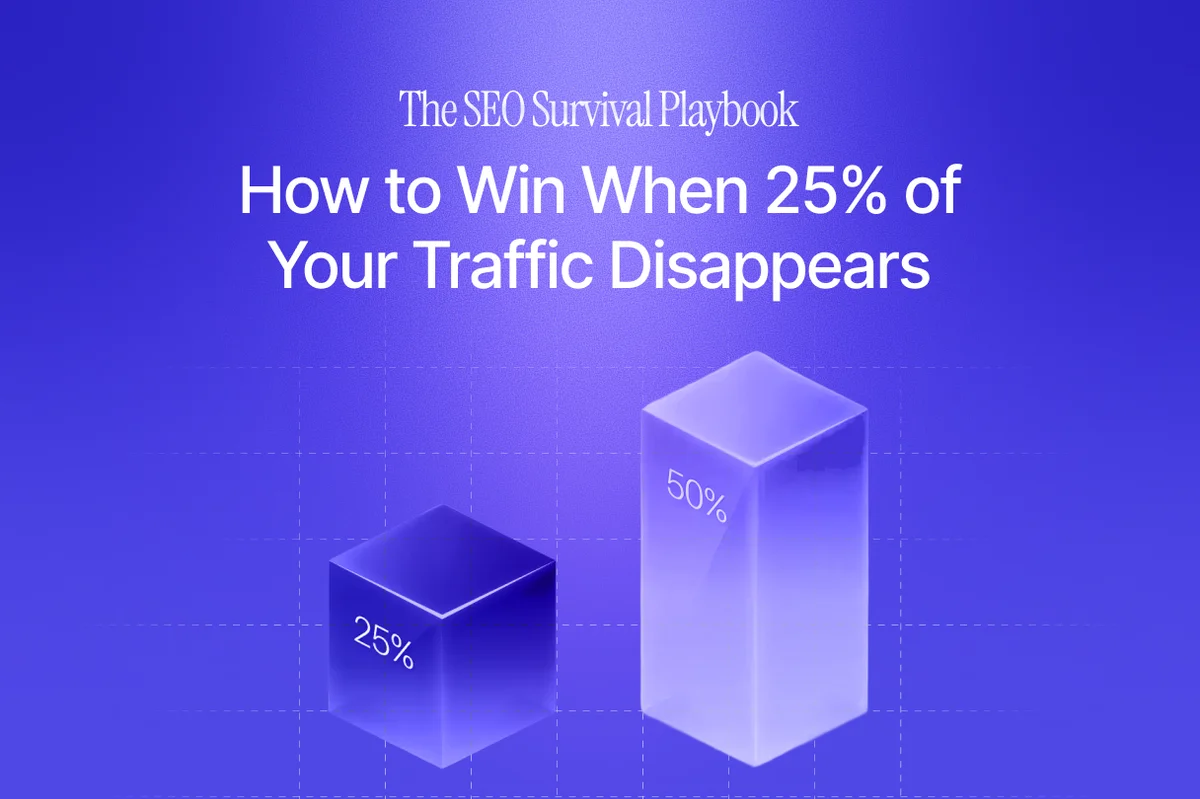
The SEO survival playbook for 2026 starts with accepting Gartner's prediction is reality: search engine volume has dropped 25% from its 2023 peak, and BrightEdge data shows 60% of Google searches now end without a click. Companies that built acquisition strategies around traditional SEO traffic are watching organic visits decline month over month even when their content quality didn't change. The survival path has five moves: prioritize commercial-intent queries that still produce clicks, build AEO…
TL;DR: The SEO survival playbook for 2026 starts with accepting Gartner's prediction is reality: search engine volume has dropped 25% from its 2023 peak, and BrightEdge data shows 60% of Google searches now end without a click. Companies that built acquisition strategies around traditional SEO traffic are watching organic visits decline month over month even when their content quality didn't change. The survival path has five moves: prioritize commercial-intent queries that still produce clicks, build AEO architecture so AI engines cite you instead of skipping you, treat branded discovery as the new hedge, double down on conversion rate where traffic is shrinking, and re-architect content production toward fewer but stronger cornerstone pieces. The playbook is real and proven; the companies dismissing it as alarmism are the ones losing the most traffic.
In 2023, Gartner predicted search engine volume would drop 25% by 2026 as users shifted to AI chatbots and virtual agents. Most marketing teams dismissed it as speculative. In 2026, the prediction is reality, and the marketing teams that dismissed it three years ago are the ones watching their organic acquisition decline the fastest.
If you're a marketing team that still has to ship pipeline this quarter while the SEO ground shifts under you, this is the playbook. Not a doom essay. A survival framework.
For the broader AEO context, see Answer Engine Optimization Guide for 2026. For the zero-click revenue mechanics, see Zero-Click Content That Still Drives Revenue.
What is the SEO survival playbook for 2026?
The SEO survival playbook for 2026 is the 5-move response sequence for B2B SaaS companies watching organic traffic drop 25 percent or more from its 2023 peak. The playbook starts by accepting Gartner's prediction is reality: search engine volume has fallen, BrightEdge data shows 60 percent of Google searches now end without a click, and AI assistants synthesize answers across ChatGPT, Perplexity, and Google AI Overviews from the same sources that used to send the traffic. The 5 moves are structural responses that restore organic-sourced pipeline even when raw click volume keeps falling.
This is different from "SEO is dead" content, which is selling fear without a fix. The honest read is that the traffic surface shrank and the citation surface grew. The brands that adapt are not waiting for Google traffic to come back; they are rebuilding for a world where the organic discovery layer runs across Google blue links, Google AI Overviews, ChatGPT, Perplexity, Gemini, and Claude in parallel. The survival playbook is the structural response that absorbs the shift instead of denying it.
Three of the 5 moves carry most of the weight:
- Restructure content for AI extraction. 40-to-60 word direct-answer blocks at the top of every section, question-shaped H2s, FAQPage schema. Pages that already rank get cited; pages that do not get rewritten.
- Shift measurement from clicks to citations. Add Share-of-Answer tracking to the dashboard. A page producing zero clicks but consistent citations across ChatGPT and Perplexity is still producing pipeline.
- Move budget from broad-funnel content to high-intent comparison and category pages. Top-of-funnel content earns fewer clicks every quarter. Mid-funnel and bottom-funnel content earns proportionally more, because that is where buyers actually convert.
How long this survival shift takes
Pivoting a B2B SaaS SEO program from informational traffic to commercial-intent + AEO citation is not a single ship cycle. The five survival moves (commercial-query prioritization, AEO architecture, branded discovery, conversion rate work, cornerstone content) compound on different curves. Three windows below.
| Timeframe | What's possible | When it applies | Real example |
|---|---|---|---|
| Week 1 to week 6 | Query mix audited, top informational pages identified for retirement or AEO rewrite, commercial pages re-templated with direct-answer blocks and schema, demo conversion friction cut | You already rank for informational queries and know which ones are bleeding clicks. The work is mechanical: cut, rewrite, reschema. | Internal LoudFace pattern across B2B SaaS clients post-Gartner 25 percent drop confirmation |
| 2 to 4 months | First sustained AEO citations on commercial-intent prompts, branded search lift starting to show in GSC, cornerstone content program shipping fewer but stronger pieces (1 to 2 per week instead of 5 to 10) | You committed to the cornerstone shift instead of just slowing the volume. The branded search hedge needs roughly this long to accumulate signal. | TradeMomentum cornerstone shift produced consistent citation lift across roughly this window |
| 6 to 12 months | Compounding pipeline from the new query mix even as informational traffic continues to decline, brand-and-trust signals visible in retargeting and direct traffic, conversion rate doubled on commercial-intent pages | The full playbook has been running on weekly cadence for two to three full quarters | Toku reached 86 percent share-of-answer over a comparable multi-quarter window combining commercial-intent and AEO architecture work |
The shift from informational to commercial works on a Q-by-Q basis, not a sprint basis. Marketing teams that try to compress it into 8 weeks tend to retire informational pages too aggressively, lose the branded search hedge, then panic when total clicks drop in week 6 even though commercial conversions are climbing. Trust the curve. The traffic graph gets uglier before the pipeline graph gets better.
The actual data, honestly
Three numbers worth knowing:
- Gartner 2024 prediction: search engine volume drops 25% by 2026 due to AI chatbot adoption. (Source)
- BrightEdge 2025 data: 60% of Google searches now end without a click. Buyers get answers in AI Overviews, featured snippets, or the SERP itself.
- Anecdotal from LoudFace clients: B2B SaaS sites with strong SEO architecture (built 2020-2023) are seeing 20-50% drops in organic clicks on informational queries between 2024 and 2026.
The traffic decline isn't uniform. Informational queries lose the most ("what is...", "how to..."). Commercial queries hold up better ("best [category] tool", "[brand] vs [brand]"). Transactional queries are mostly stable.
The 5 survival moves
1. Prioritize commercial-intent queries that still produce clicks
Three query types in 2026, ranked by remaining click value:
- Transactional ("buy [product]", "pricing for [brand]"): nearly 100% click retention. AI engines don't try to answer these; they route the buyer.
- Commercial ("best [category]", "[brand] vs [brand]", "[category] for [use case]"): 50-80% click retention, depending on the AI engine's behavior. AI engines often summarize but include 3-5 brand citations with click options.
- Informational ("what is...", "how to..."): 20-40% click retention. AI engines synthesize complete answers; buyers rarely click through.
Survival move: shift content production budget from informational SEO toward commercial-intent SEO. The clicks that remain are also higher-intent. A 30% drop in informational clicks combined with a 15% drop in commercial clicks but a 40% increase in commercial-intent conversion rate often produces a net pipeline INCREASE.
2. Build AEO architecture so AI engines cite you instead of skipping you
The buyers using AI engines for category research still exist. They're just not clicking. If your content gets cited in the AI answer, you build brand recall at the moment of buyer intent. If your content gets skipped, you're invisible.
The four core AEO patterns from the canonical Answer Engine Optimization Guide for 2026:
- 40-60 word direct-answer paragraphs at the top of every page
- FAQPage schema in JSON-LD on every cornerstone piece
- /answers directory with single-question pages
- Programmatic page trees tied to real buyer prompts (Peec AI baseline audit)
Without AEO architecture, the SEO traffic loss is permanent. With AEO architecture, the loss converts to AI citation gain (different surface, similar pipeline impact).
3. Treat branded discovery as the new hedge
Branded search (buyers typing your brand name into Google) is the most resilient organic channel in 2026. It bypasses AI synthesis (the AI engine isn't trying to answer "who is LoudFace") and goes directly to your site.
Survival move: build branded search lift on NEW queries as a primary KPI. The mechanic:
- AI engines cite your brand → buyers see brand exposure
- Buyers later search your brand name in Google → branded search session
- Branded search converts at 3-5x non-branded organic
- Pipeline grows even as informational organic shrinks
GSC's "Queries" tab shows branded search trend. New branded queries appearing month-over-month are the leading indicator that AEO is converting to brand discovery. See Zero-Click Content That Still Drives Revenue for the full mechanics.
4. Double down on conversion rate where traffic is shrinking
When traffic drops, conversion rate matters more per visit. Marketing teams that hit a traffic cliff and let conversion rate stay flat see pipeline drop linearly. Teams that focus on CRO during the cliff often hold pipeline flat or grow it despite lower traffic.
Three specific CRO moves for the 2026 traffic profile:
- Higher-intent visitors deserve higher-intent landing pages. The buyers who reach your site after AI engine exposure are 3-5x more valuable than 2020 organic. Treat the hero, the CTA, and the first 3 sections as commercial, not awareness content.
- Forms shorter, friction lower. Buyers researched upstream; the form should ask only what's strictly required. Pre-fill via UTM where possible.
- Pricing transparency reduces drop-off. Hidden pricing was tolerated in 2020 demand-gen; high-intent 2026 buyers tend to bounce. If your pricing is custom, show ranges + tier descriptions.
5. Re-architect content production toward fewer but stronger cornerstone pieces
The 2020 SEO playbook was high-volume. Publish 4-8 SEO blog posts per month, hit long-tail queries, rank for thousands of low-intent keywords. That worked when informational SEO converted to traffic.
The 2026 SEO playbook is high-quality. Publish 1-3 cornerstone pieces per month with full AEO architecture, target commercial-intent queries, build Citation Authority over 6-12 months.
The shift in practice for LoudFace clients:
- Pre-2024: 30+ blog posts per quarter, 60% informational, 30% commercial, 10% commercial transactional.
- 2026: 6-10 cornerstone pieces per quarter, 80% commercial, 20% transactional. Each piece is 1500-3000 words with full AEO architecture and named practitioner byline.
Net effect: fewer pieces but each one produces measurable AI citations + branded search lift over 6-12 months. The unit economics are better despite the throughput dropping.
The two diagnostic numbers that tell you where you are
If your team is anxious about SEO right now, two questions narrow the diagnosis:
- What's your year-over-year informational-query click trend? If down 20-50%, you're in the normal range. If down >50%, the SEO architecture probably wasn't strong to begin with. If flat or up, you're either very niche or measuring wrong.
- What's your year-over-year branded-search-on-NEW-queries trend? If up 30%+, AEO is working and the SEO loss is being absorbed by branded discovery. If flat, AEO architecture is missing OR isn't being implemented effectively. If down, the brand has visibility problems that go beyond SEO.
The combination tells you whether the survival playbook is working. Healthy: informational down, branded NEW queries up. Unhealthy: informational down, branded NEW queries flat.
When the survival playbook doesn't apply
Two patterns:
- Transactional / e-commerce sites. Your traffic is mostly transactional intent. Click retention is high. The playbook's first three moves are over-scoped; focus on CRO and branded discovery moves only.
- Brand-new categories AI engines have no training data on. AEO architecture pays off when AI engines understand the category. Pioneering categories rely on direct demand generation, not on hedging against AI-mediated SEO loss.
For most B2B SaaS, fintech, professional services, and content-heavy publishers, the playbook is the right framework. Apply it.
The honest takeaway
SEO survival in 2026 isn't about defending against an attack. It's about accepting a structural shift in how buyers research and rebuilding the program for the new reality. The companies that ship 30 SEO blogs per month hoping volume will save them are losing the fastest. The companies shipping 6 strong cornerstone pieces with full AEO architecture, branded discovery campaigns, and conversion rate discipline are holding flat or growing pipeline despite the traffic decline.
Pick your survival moves based on your category. Implement the AEO architecture. Build branded search as the hedge. Stop measuring success in informational click volume; start measuring it in pipeline from organic + AI-cited sources.
For the canonical AEO playbook, see Answer Engine Optimization Guide for 2026. For the zero-click revenue mechanics, see Zero-Click Content That Still Drives Revenue. For help structuring an SEO survival program, we run 12-month dual-track engagements.
Working on a B2B SaaS or fintech growth program? We run a free 30-minute AI citation audit. We open the dashboard, walk through the prompt graph for your category, and tell you what's working (or who else can help). See our public pricing first if that helps.